Paper VII · version 1.6
OMEGA marked reference geometry
This page indexes Paper VII, version 1.6. The Construction-to-OMEGA theorem proves that these data, together with the selected major arc, determine exactly one marked kernel: six baseline marks, every distance among those marks and from them to α, all fifteen pairwise center angles, rank-two Gram data, and an oriented frame in R³. The one-arcsecond seed, orientation, and sequential bilateral a, aφ extensions are the construction data; those extensions are additional declared rules, not consequences of the arcsecond. The metric outer scaffold is an adopted transcription of the notebook a, aφ annotations. Remaining outer curves and signed-depth completion are not claimed.

Start here
- Object
- A specified circle, a one-arcsecond opening, and bilateral straight extensions locate six labeled marks.
- Result
- The construction fixes the marked kernel once its center, scale, and oriented frame are supplied. Selected measurements give G = aφ and C = aπ.
- Example
- Set a = 1 with the identity pose. Inspect the six coordinates, then move the camera. The exported construction parameters stay the same.
The selected readout is G + C. The length of the entire outline is a different observable.
24 October 2026 supplementary development
The geometric arithmetic compatibility note gives an explicit pointwise link between the selected scale family and its rational floor implementation, including discrepancy accumulation and ordered-witness reconstruction. The reference recovery note treats measurement and representation more generally. These notes use the existing kernel. The published source works and frozen SRSD remain unchanged.
Geometric arithmetic compatibility and recovery. Reference geometry and recoverable relationships. G = (aφ + aφ) / 2 = aφ. C remains the opposite semicircle, not the entire retained major arc.
Source work: Paper VII, version 1.6. Zenodo preprint. DOI 10.5281/zenodo.22233573. Not peer reviewed. The companion generator evaluates the closed formulas; it is not a theorem checker.
This branch is separately defined Euclidean geometry. It does not join Papers I–VI into one theorem, and it does not modify frozen SRSD.
Machine objects omega-marked-kernel and construct-transfer-gate are listed in /archive/MACHINE.json. Reconstruct from the node log and declared constants; do not digitize the figure.
Claim boundary
The input data are a center , a positive scale , an oriented Euclidean plane through , and an ordered pair on the radius- circle with central separation . The chord direction is then extended outward by and by on both sides. Those extensions are declared rules. They are not derived from the arcsecond. Only the golden-ratio identity is used in the bilateral extension.
Version 1.6 proves that this rule set, together with the selected major arc, determines exactly one marked kernel: six baseline marks, every distance among those marks and from them to , all fifteen pairwise center angles, rank-two Gram data, and an oriented frame in . The six baseline marks are collinear (affine dimension one). The center-augmented configuration has affine dimension two.
The metric outer scaffold in Section 11 is an adopted transcription of the repeated notebook annotations. It defines Space, Echo, and Loco once that rule is adopted. The larger circle and additional curved links in the expanded notebook drawing are not required for Theorem 3.4 and Proposition 9.1. Genuinely nonplanar completion remains an open constraint stage.
Selected measurements
Each inner straight segment has length . Each outer golden segment has length . Each complete foot has length . The opposite semicircle has length . The selected golden readout is the average of the two outer segments. The selected circular readout is that opposite semicircle. Those are the measurements defined in the hosted proof source.
Reconstruction record
A receiving system rebuilds the labeled kernel from and the master formula . Scalar records do not place the figure. Scaffold data travel only if separately adopted.
Reconstruction record
Geometric record . Master point formula . Canonical pose: α = 0, a = 1, u = (0,−1,0), v = (1,0,0), n = (0,0,1). Schema OMEGA_KERNEL_NODES/1.0. Display exaggeration never enters the export.
- Kernel nodes
- α, d, b, d₁, b₁, d₂, b₂
- Excluded
- outer_circle, clam, shell, extrusion, signed_depth
- True opening
- pi/648000
- Display angle
- 12° non-normative
Affine dimension of the six baseline marks is one. Adjoining α gives affine dimension two. The frame places that plane in oriented R³. Uniqueness is of the labeled kernel up to the stated isometries; positive scale gives the similarity family. Scaffold S, E, L is a separate adoption.
Not run. The check fetches the hosted JSON, validates the schema, reconstructs each kernel point from the hosted frame and (u, v) coordinates, and compares those coordinates to the hosted xyz.
Construction-to-OMEGA theorem
Theorem 3.4. Fix , , the ordered seed , and the sequential bilateral extension then . The Construction-to-OMEGA theorem proves that these data, together with the selected major arc, determine exactly one marked kernel: six baseline marks, every distance among those marks and from them to , all fifteen pairwise center angles, rank-two Gram data, and an oriented frame in . Equivalently, the following are uniquely determined up to orientation-preserving Euclidean isometry:
- the six marks ;
- all pairwise distances among them and from them to ;
- all fifteen pairwise angles subtended at ;
- every triangle with vertex and two baseline marks;
- the normalized configuration Gram matrix;
- an oriented orthonormal frame in any oriented realization in .
The six baseline marks are collinear and have affine dimension one. The center-augmented configuration has affine dimension two.
The shape, its structure, and the transfer gate
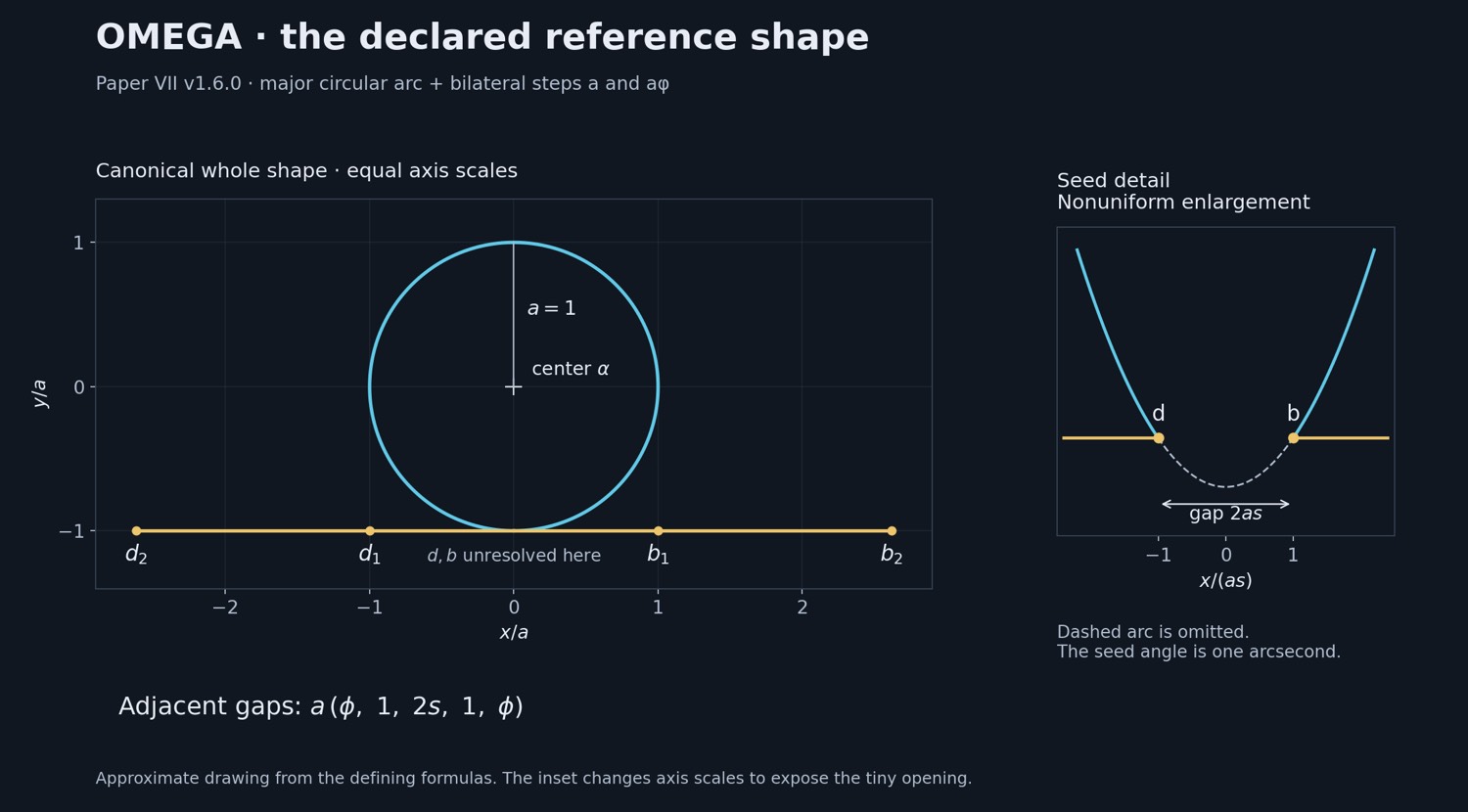
The OMEGA shape on this page is a marked planar kernel, not a volume and not a unique outer shell. In any oriented realization it is a rigid figure in a plane through the distinguished center α: the Paper VII arc-and-feet curve Γ (the selected major arc joined to two outward golden feet), six collinear baseline marks on the line y = −a cos(ε/2), and the center off that line. Only the seed pair lies on the radius-a circle; those two points are joined by the retained major arc, not by a straight chord. This is the existing construction, not a different object. The third direction is only the oriented normal of that plane.
Structure, in the sense of Theorem 3.4: the six marks lie on one affine line. Adjoining produces an affine plane. The master reconstruction is with , , (normalized coordinates , in units of ). The complete curve is the existing arc-and-feet object , not a circle with marks on a diameter and not a new discovery. Distances, the fifteen pairwise center angles, the rank-two Gram factorization, and the oriented frame are then unique up to orientation-preserving Euclidean isometry and positive homothety about . That is the whole rigid object. A receiving constructor that is given those nodes has the kernel, and does not have a unique shell.
Construct mode and the node log are a transfer gate for that kernel. A receiving system can rebuild the unique labeled similarity class in R³ from the exported nodes, exact-expression strings, and binary64 coordinates. The gate is typed: kernel data may pass; the scaffold passes only if separately adopted; exclusions never become drawable nodes. Display exaggeration does not travel. The scalar map between (φ, ε) and (τ_Ω, λ) is a side channel of numbers, not a reconstruction of the geometric realization, and not a joining theorem.
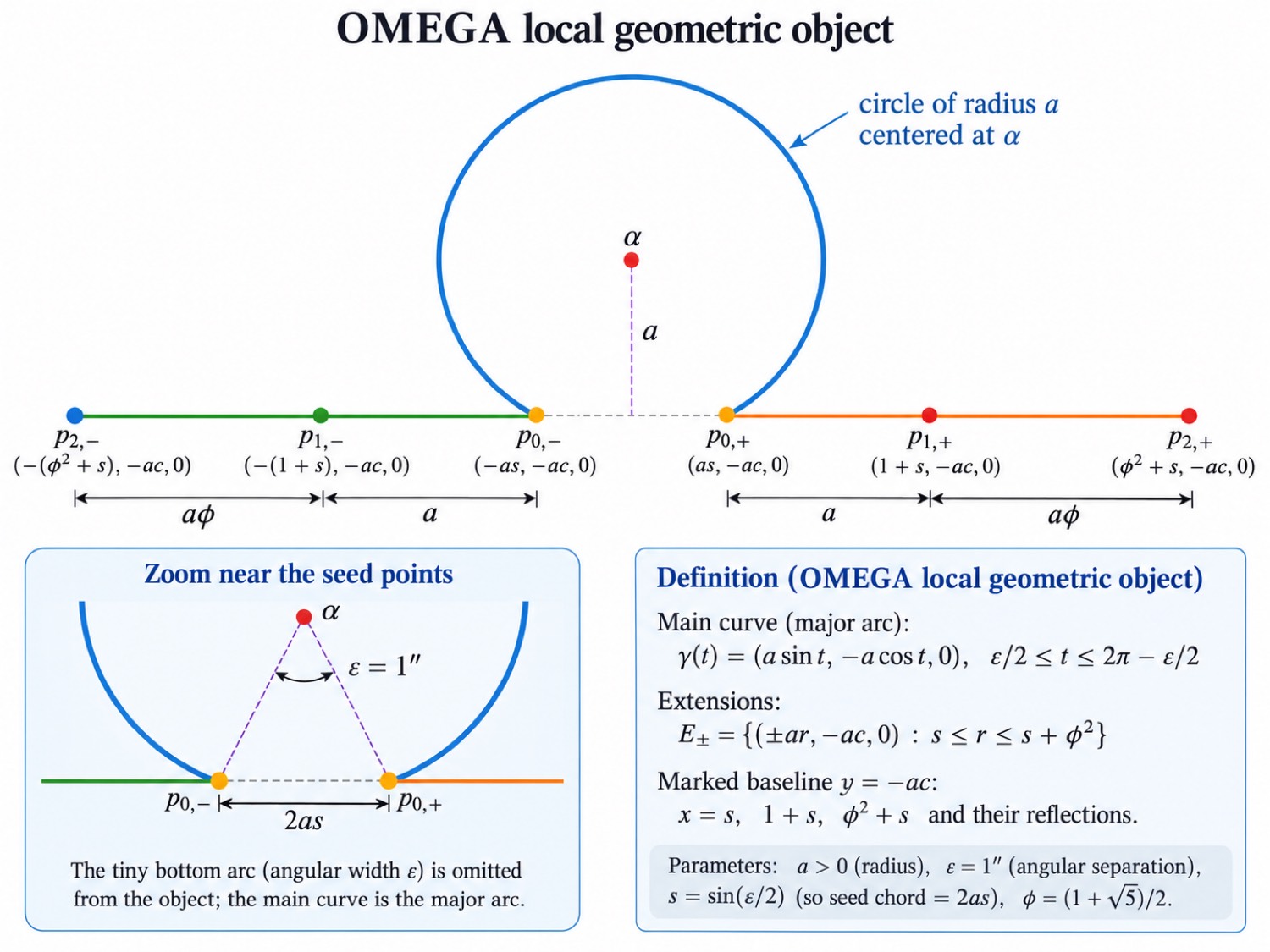
Definition (OMEGA local geometric object)
Main curve (major arc): .
Extensions: .
Marked baseline . Physical coordinates . Equivalently, the normalized list is in units of . Consecutive separations ; the middle is the seed chord, not a segment of .
Parameters: , , , . This is the Paper VII construction, not a different object.
Frame and placement
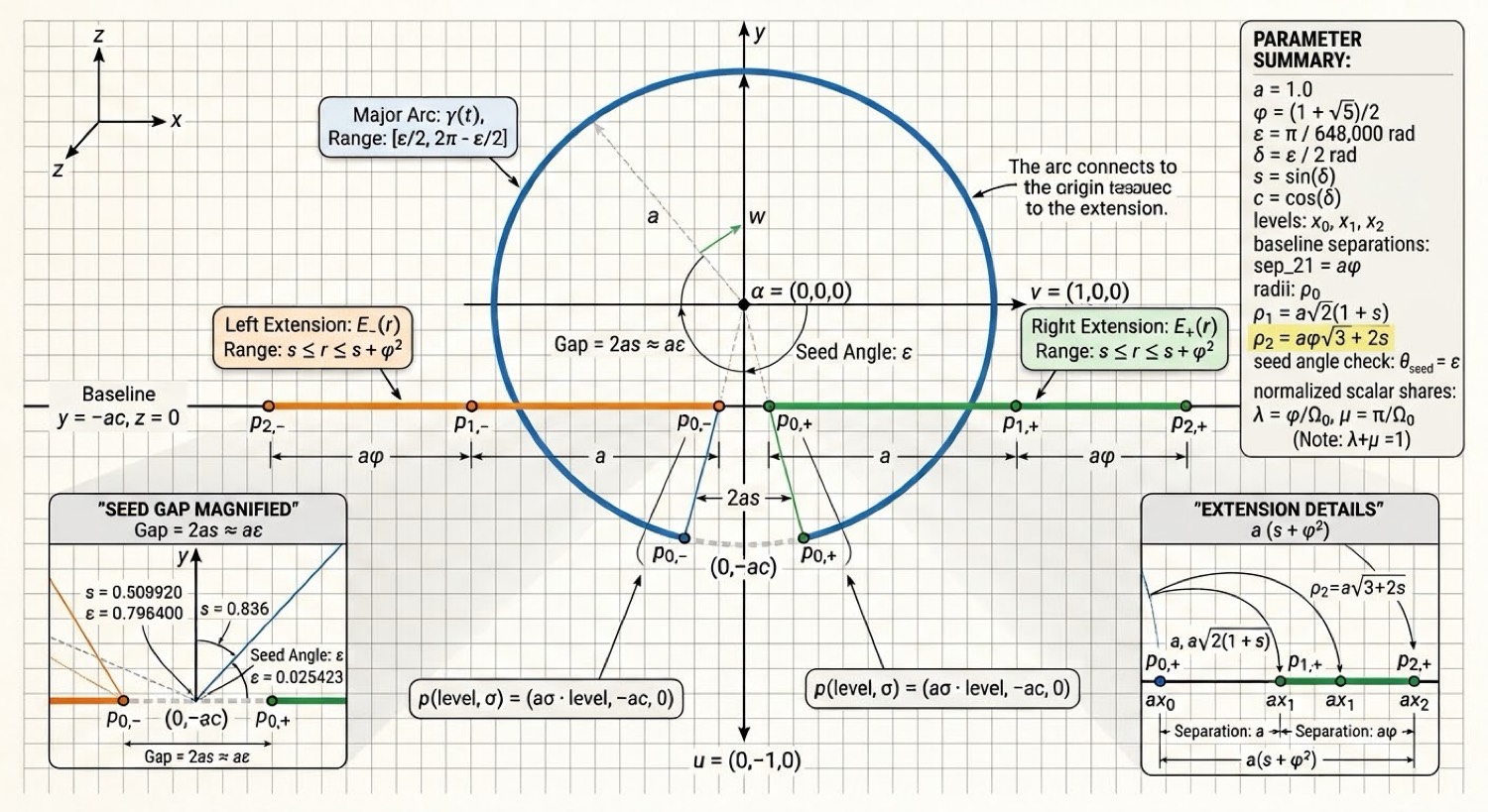
, , , . Marks with normalized (units of ; physical abscissae ).
Seed chord . Small-angle reading is an approximation, not a replacement for .
Radii (exact)
, , . The last factor of is required. and are selected-measurement scalars; they do not place the marks.
Uses of the gate, and not more: interchange so another system can recreate the planar kernel in from the node log; isolation of the 12° picture from the true one-arcsecond seed; a typed latch that will not silently promote the adopted scaffold or an excluded outer drawing to kernel status; and a scalar chart-change that does not reconstruct a geometric realization without center, scale, frame, and construction data. The gate does not prove cubature, does not modify frozen SRSD, and does not join Papers I–VII.
Euclidean homothety of the six marks is the scaling checked in the de-branded typed-map audit. That audit identifies maps; it does not join Papers I–VII and does not transfer a unique shell. See Typed network. A Lean 4 formalization of the selected geometric-provenance measurement is inventoried at /formal; sources are hosted and hash-matched, lake build PASS on this archive 2026-09-13, and it is not a uniqueness theorem among all measurements.
Marked kernel · transfer gate
kerneloptionalnot impliedPasses
Proved kernel
- six labeled marks and the center
- all distances among them
- fifteen center angles
- rank-two Gram data
- oriented frame (u, v, n)
- selected major arc
Adopted only
Notebook scaffold
- Space, Echo, Loco after kernel completion
- separate jump; replay cannot enter
- not a consequence of the one-arcsecond seed
Stopped
Does not travel
- outer circle, clam, shell
- extrusion and signed depth
- 12° display coordinates
- cubature theorems or SRSD as a foundation
Construct mode
Construct mode is the presentation and interchange layer of the Paper VII kernel. It reveals the marked planar kernel in fifteen sourced stages, exports OMEGA_KERNEL_NODES/1.0 at the true one-arcsecond seed, and keeps a 12° picture strictly non-normative. Automated replay stops at kernel completion. The adopted scaffold is a separate jump. This layer does not replace the Euclidean proof, does not introduce a second geometric evaluator, and does not determine an outer curve or signed depth.
Technical release paper, 6 September 2026, not a source work and not peer reviewed: OMEGA_Kernel_Construct_v1.1.0.pdf · 368491 bytes · SHA-256 6b2593e2ad232793296b8e8b3acadcc8a71d240b5e8c799342d90cd1815bd912. Node contract OMEGA_KERNEL_NODES/1.0. Canonical unit log: omega-kernel-nodes.unit.true.json. Scalar certificate: verify_scalar_interface_exact.py. The live evaluator remains paper-vii-kernel.ts.
Construct mode · v1.1.0
kernelstage 15 / 15Major-arc kernel closure
Added. Selected major arc through the long complement of the opening.
Determined by. The seed opening and the circle of radius a.
arc from b to d the long way; length a(2π − ε)
Source. Definition 3.3; proof Steps 3–4
Why this step. This closes the marked kernel. Remaining notebook curves and signed depth are not claimed.
Construction complete. Replay from the beginning, or jump to the optional scaffold.
this stage: minor-arc · major-arc · kernel-complete
Exported JSON always uses true . Display coordinates never enter the node log.
Interface checks
Adapter and validator only. Not a theorem checker, not independent reproduction, and not a second geometric evaluator.
- holdCanonical node log matches paper-vii-kernel.ts10 nodes, z = 0, true ε
- holdExclusion ledger closedouter_circle, clam, shell, extrusion, signed_depth
- holdS, E, L map to spacePoint, echoPoint, locoPointoptional chapter only
- holdExport uses true one-arcsecond seed12° display is non-normative
- holdAutomated replay stops at kernel stage 15Proposition 5.1; scaffold is a deliberate jump
- holdOverlay catalog closed against the fifteen-stage screenplay20 overlays, including adopted scaffold
Overall: interface holds
paper-vii-kernel.ts.One-arcsecond seed and bilateral extensions
Write , , . Let be the unit internal bisector and the positively directed unit chord. Then
The first and second outward marks are , , , . The six marks have the uniform form
The quantities are normalized coordinates (units of ). Physical baseline abscissae are .
The total baseline width is . The one-arcsecond chord survives exactly as the excess over the bilateral golden total .
Complete center-angular fan
Theorem 6.1. The three positive bearings from the bisector are
Numerically . The outer golden increment is with
Every center angle is a difference of signed bearings , or equivalently
Radial lengths: , , . The last identity uses .
Binary64 materialization of the unit-scale object: major arc, golden feet, six center rays, and the Definition 11.1 scaffold. Drag to orbit; scroll to zoom. The companion Julia script evaluates the same formulas. is a numerical check of the factorization, not the proof.
- θ₀
- 0°00′00.50″ (0.5″)
- θ₁
- 45°00′00.25″
- θ₂
- 69°05′41.496848751″
- γ = θ₂ − θ₁
- 24°05′41.246848751″
- ∠d₂αb₂ = 2θ₂
- 138°11′22.993697502″
- ρ₀
- 1.000000000000
- ρ₁
- 1.414215276447
- ρ₂
- 2.802519341385
- W constructed
- 5.236072825637
- H constructed
- 5.236067977500
- L_chord constructed
- 4.848137e-6
- W − H closed form
- 4.848137e-6
- ‖S − α‖
- 1.618033988753
- rank Ḡ
- 2 (factorization check, not a proof)
- center angles
- 15 unordered pairs |βᵢ − βⱼ|
Browser evaluation of the closed formulas
This is a reconstruction check of the published identities. It is not a proof assistant and not a public certificate package.
- holdθ₀ = ε/2θ₀ = 0.500″
- holdθ₁ = π/4 + ε/445°00′00.25″
- holdθ₂ = arctan((φ² + s)/c)69°05′41.496848751″
- holdtan γ = tan(π/4 − ε/4)/√5γ = 24°05′41.246848751″
- holdUnit-scale landmarks match the published 16-digit recordcanonical frame α=0, u=(0,−1,0), v=(1,0,0)
- holdC(δ) = b and C(2π − δ) = dmajor-arc parametrization of Proposition 9.1
- holdW − H = L_chord (closed forms)W−H = 4.848137e-6 at unit scale
- holdconstructed ‖T₊−T₋‖ ≈ ‖T₋−E‖ + ‖b−d‖W−H−L_chord = 2.912e-17
- hold‖S − α‖ = a(φ² − c) = aφ + h_sag‖S−α‖ = 1.6180339887528330
- holdρ₀ = a, ρ₁ = a√(2(1+s)), ρ₂ = aφ√(3+2s)ρ₁ = 1.4142152764472637, ρ₂ = 2.8025193413849330
- holdrank X_Ω = rank Ḡ_Ω = 2 (numerical factorization check)UᵀU = diag(6c², ∑zᵢ²); both entries positive. Not the proof.
- holdCenter-angle law agrees with |βᵢ − βⱼ|all 15 pairwise center angles
- holdSix signed bearings determine 15 unordered center angles15 pairs from β = (−θ₂,−θ₁,−θ₀,θ₀,θ₁,θ₂)
- holdḠ = c² 11ᵀ + zzᵀ with ∑zᵢ = 0∑zᵢ = 0.000e+0, ∑zᵢ² = 15.708239013982
Overall: identities hold
Gram closure and intrinsic rank
Collect the normalized center-relative landmark vectors as columns of in the basis . The physical configuration is . Write
The normalized Gram matrix is with entries . For general scale, .
Proposition 8.1. Because symmetry gives ,
Both diagonal entries are positive, so . That is the proof. A floating-point rank of the binary64 image is a numerical check of the same identity, not a substitute for it. The local kernel is a rigid marked plane, not a volume object. Rank two does not prevent exact use in : the third basis vector is the oriented normal.
Exact realization in oriented Euclidean three-space
Proposition 9.1. From an ordered seed in oriented put , , and
The entire local kernel is reconstructed by the master point equation . Its circular body is for , and the two feet are of length . Every point of the local kernel satisfies .
The Oriented R³ panel materializes the same object: 500 samples of the major arc, 100 samples on each golden foot, the six landmarks, the six center rays, the Definition 11.1 scaffold, and the center. Drag to orbit. The companion Julia script evaluates the same binary64 image, including the Gram factorization and all fifteen pairwise center angles. LinearAlgebra rank and floating-point comparisons check that image; they do not prove the theorem.
Positive homothety about acts freely and transitively on . Lengths scale by the factor, Gram entries by its square, and the complete angular fan is independent of . An element of places the canonical object anywhere in oriented three-space without changing distances, center angles, incidence, or handedness.
Views, thickness, and revolution
Front from +n. Retained arc: 2π − ε · each complete foot: φ²a.
One-arcsecond opening · unequal axis scales
Lengths divided by a · display strokes have no physical thickness
The same cameras, without the rest of this page, are at /geometry/canonical.
Exact identities and numerical checks are different evidence. follows from . A floating-point residual of zero checks an implementation. The seven kernel nodes are and the six marks. Agreement with the stored binary64 coordinates in the node log, including a maximum coordinate difference of zero, establishes agreement with those stored values. It is not an exact-arithmetic certificate.
A view is a camera, not a second curve. Planarity is . The orthogonal view along shows the full outline. A view along either in-plane axis collapses it. With and ,
is the image of a view along , and
is the image of a view along . Naming either collapsed image “plan” or “side” records the chosen orientation. In the hosted identity pose, , , , , and .
The marked curve and its selected readout are determined. Thickening, sweeping, extrusion, and revolution are not. If stays the centerline, the six marks and the spine quantities , , and the outline length stay the measurements of that spine. An offset boundary generally has a different length. A sweep also needs a cross-section orientation. At the nonsmooth joins and the curve does not supply a unique transverse normal plane. remains that selected sum. It is not a scaffold width and not an offset length.
Revolution is a valid additional construction once an axis is specified. Whether labeled features merge depends on that axis, and a point cross-section does not prevent a merger. Revolving the canonical kernel about the -axis of the identity pose sends both feet onto one annulus
The circular component generates the spherical surface
Those are consequences of that chosen revolution, not source geometry. This account adds no thickness and no depth.
Notebook outer scaffold
Definition 11.1 adopts the repeated outer annotations as total half-height above and below the baseline, using the already determined endpoints as side coordinates. Writing and ,
Proposition 11.3. Scaffold width and height are and , hence . The exact departure from a square is the one-arcsecond chord length. At , and .
The same identities give . The companion Julia script and the browser check compute , , and from the constructed coordinates, then compare at 64 machine epsilons. That is a binary64 identity check of the constructed points, not a re-typing of the closed forms.
This is an adopted transcription of a drawing rule, not a uniqueness theorem for the whole notebook figure. The larger circle and additional curved links remain optional Euclidean objects to be solved only after their incidences or radii are fixed. A genuinely nonplanar point is represented as ; signed-depth completion is the last stage of the hierarchy
The first three stages are explicit in this preprint. The last is not claimed here.

Claims on this branch
| Claim | Mathematical status | Evidence | Machine-checkable? | Publication |
|---|---|---|---|---|
| Construction-to-OMEGA uniqueness of the marked kernel | theorem claim | paper proof, Theorem 3.4 (Construction-to-OMEGA) | closed formulas evaluated by the companion generator and a browser reconstruction check; not a theorem checker | Zenodo preprint; not peer reviewed |
| Three fundamental bearings and the complete center-angular law | theorem claim | paper proofs, Theorem 6.1 | float64 evaluation of the closed formulas; not a theorem checker | Zenodo preprint; not peer reviewed |
| Exact 3D reconstruction and positive-homothety family | theorem claim | paper proofs, Proposition 9.1 and Section 10 | companion generator exports landmarks, JSON, and sampled OBJ; not a theorem checker | Zenodo preprint; not peer reviewed |
| Notebook outer scaffold is an adopted transcription; remaining completion is not claimed | adopted definition plus derived identities in the Zenodo preprint; remaining outer completion is a status statement | Paper VII v1.6 Definition 11.1, Proposition 11.3 | identities W-H=L_chord and \|S-\alpha\| evaluated in the browser check; not a uniqueness certificate | Zenodo preprint; not peer reviewed |
| Experimental 4D OMEGA rotation is not a privileged memory anchor | numerical experimental control; not a theorem | published results.json of OMEGA_DRIFT_EXPERIMENT_v0_1, seed 20260831 | Python/NumPy script; numerical reproducibility of the named run, not a theorem checker | locally hosted experimental control; not peer reviewed |
| Kernel construct node log and presentation machine | implementation interface around Paper VII; not a theorem and not a second evaluator | live paper-vii-kernel.ts landmarks; canonical unit JSON; browser construct machine; exact scalar-interface Python certificate (scalar layer only) | node-log validator against the live evaluator; overlay catalog closed; replay boundary; Python exact scalar certificate does not prove Euclidean claims | locally hosted technical release paper; not peer reviewed |
| Six-mark projective recognition, landmark decoding, and baseline integration bounds | written additional consequences developed in exploration 02 using established methods. Not a theorem of Paper VII. Canonical seed remains one arcsecond. Priority of the applications is not assessed. | note 20104 bytes SHA-256 12f3106a7980ce56e328c3ae29392f306c1c321e4c7c92decbce38fa00560513; OMEGA_Object_Exploration_02.py 15581 bytes SHA-256 4c1b3cfa46262e21d19ece458d4dcb8fccd617d15ca4579a2f013108396c13a6; this-archive Python 3.10.21 / SymPy 1.14.0: 21 check groups PASS (19 mathematical + 2 malformed-input); 15+15 affine recovery patterns; 6+20 projective recovery patterns; truncated/empty/scalar/budget rejections; named author files 6c35365d… / e50f3443… were not in the upload | OMEGA_Object_Exploration_02.py on this archive; 21 groups PASS from len(checks). Symbolic checks corroborate the note; they are not a proof-assistant certificate. Named author replacement hashes were not received. | locally hosted exploration note; not peer reviewed |
| Positive quadrature classification for the symmetric six-node family | Written proofs in PROOFS.md. Computational checks corroborate selected identities. Not a theorem of Paper VII. Canonical seed remains one arcsecond. | PROOFS.md 28146 bytes SHA-256 99d6b58e…; verify.py 18356 bytes SHA-256 381d091c…; Verify.java 23485 bytes SHA-256 4b00c0ee…; this-archive Python 3.10.21 and OpenJDK 17.0.20: four executions byte-identical to expected.txt 7ef550cb…, TOTAL 21 PASS; author evidence hosted: python/java/rust stdout (7ef550cb…), rust-build stderr, version-cargo, version-java; author REPRODUCTION_REPORT.md records eight matching runs including Julia/Rust; verify.jl and the Rust crate were not received here | verify.py and Verify.java on this archive; stdout must match expected.txt. Not a proof-assistant certificate. Julia and Rust not replayed. | locally hosted note; not peer reviewed |
| Boundary reconstruction, volume-preserving transport, and an invariant cubic | Written proofs in the 21 September 2026 PDF and the 22 September 2026 remarks. Not a theorem of Paper VII. Not a source paper. | PDF 344230 bytes SHA-256 a8c9e39e… (unchanged); restored TeX 27553 bytes SHA-256 fcaadf4b…; paste as received 7db0d779…; REMARKS.md 7927 bytes SHA-256 9c217a5e…; checker 2026-09-22.r2 10661 bytes SHA-256 ce3e5ea2…; this-archive Python 3.10.21 / NumPy 2.2.6 captured 2026-09-22T12:35:49Z: TOTAL 30 PASS, stdout 60ad47fa… bound to checker ce3e5ea2…; four negative controls reject | verify_boundary_reconstruction.py revision 2026-09-22.r2 on this archive; stdout must match this_archive_verify.stdout.txt and ENVIRONMENT.json must name checker SHA-256 ce3e5ea2…. Exact Fraction check of the J² spherical mean only. Remaining groups are numerical. Not a proof-assistant certificate. | locally hosted note; not peer reviewed |
| Explicit minimal ten-sample reconstruction of H≤2 ⊕ ℝJ | Written supplementary note, 23 September 2026. Not a theorem of Paper VII and not an additional counted source paper. Ten is minimal for scalar point samples on this space. The thirteen-sample arrangement's three consistency equations are not an error-correction guarantee. General transport is the written argument; two rational executions are finite checks. | checker verify_ten_sample.py 12288 bytes SHA-256 cc850bda469cb33cc9d37c307dceede7e1b4e5ede002957c3ff7497c7a388c0f; supplied verification.txt and verification_optimized.txt, each 1186 bytes, SHA-256 a6e04971faf30e665f00fc1b60a16488dddce315a83d715291b5298031268be0; this-archive Python 3.10.21 at 2026-09-23T23:53:35Z: both python3 and python3 -O exited 0 and matched that transcript; author record names Python 3.12.14; stdout bytes agree; canonical Ten_Sample_Reconstruction.md hosted, 9973 bytes, SHA-256 967bc8afe442d6b0763f5d563b993a368161243d0f23b7274be46936d81639fe | verify_ten_sample.py, standard library only. TOTAL 13 PASS. Exact algebraic comparisons. Not a proof-assistant certificate. | locally hosted supplementary note; not peer reviewed |
| Exact field interface for the golden algebra | Supplementary note, 25 September 2026. Established field arithmetic and its specified application to existing OMEGA objects. Not an additional source paper. The checker does not prove the Galois correspondence or the transcendence of pi. | Exact_Field_Interface.md 8938 bytes SHA-256 30b1c4c58f0baa470052a5d1aa3eaf98fed6cf117e11e57c4fe38cf925e0f0f4; verify_exact_interface.py 17597 bytes SHA-256 d51b7595348d067163c08b88a7726b761662471a1f9b380201114d0112417bfd; verification.txt and verification_optimized.txt, each 1895 bytes, SHA-256 345931205dac7acbf49422ca727e55ea333badc37ce3329f612a6ef7813d3977; coefficient_record.schema.json 1588 bytes SHA-256 cd1b481dae752eae12f098d94317a1a2c17798a5b9eb9f669db9d110136f33e1; this-archive Python 3.10.21 at 2026-09-25T02:39:45Z: python3 and python3 -O both exited 0, TOTAL 29 PASS | verify_exact_interface.py, standard library only. TOTAL 29 PASS under python3 and python3 -O. The coefficient schema is applied by that checker. Not a proof-assistant certificate. | locally hosted supplementary note; not peer reviewed |
| Ellipse and operator note, documentation only | Documentation of a hosted derived note. Not a theorem status, not a Paper VII amendment, and not an additional source paper. | hosted files at /geometry/operator-bridge; supplied Python logs were not rerun; Julia was not executed | no new check in this entry | locally hosted derived note; not peer reviewed |
| Six-mark sampling polar, with a conditional packing | Direct identities for the declared sampler and sample bound. The packing statement is conditional on two external hypotheses that this note does not establish. Not a source paper and not an amendment of Paper VII. | NOTE.md 27115 bytes SHA-256 3e7f731acaaa05c4428ec4de3da5bb65873b3b581da51a52f20c668108ef7a66; this archive Python 3.10.21 on 2026-10-08: four exact lines, exit 0 under python3 and python3 -O; A-087 and A-343 were not executed | Appendix A rational-seed checks only. Not the canonical sine seed and not the external symplectic statements. | locally hosted derived note; not peer reviewed |
| Transition invariants: symbolic identities and a finite ledger audit | An exact symbolic-algebra checker with a finite canonical-ledger audit. Both executions reproduce the declared checks. Neither establishes physical unification or independent mathematical review. | OMEGA_Transition_Invariants_Proof.py 12112 bytes SHA-256 e94400b6e136bed009388c5d17e4f1c698235b7b938f75c266bbaf363a15a0ca; supplied record Python 3.12.14 at 2026-10-11T23:19:35Z names that source hash; a matching hash checks byte integrity and does not itself verify that the recorded execution occurred; this archive Python 3.10.21 on 2026-10-11 executed the hosted bytes: exit 0 under python3 and python3 -O; pass lines agree; 753664 prefix invariants on seeds 0-32767 and horizons 1-23; maximum extinction step 10 | Symbolic identities for the free variables named in the source, plus 753664 prefix checks on seeds 0-32767 and horizons 1-23. Not the canonical sine and not a physical calibration. | locally hosted derived note; not peer reviewed |
| Self-similarity, numerical difference, and exact recovery | The hosted note states five conclusions and written arguments for them. This archive has not reviewed those arguments as a proof. The checker rerun reproduces the declared symbolic checks, rational certificates, and finite ledger audit. Not a source paper and not an amendment of Paper VII. | omega_geometry_recovery_verify.py 16815 bytes SHA-256 e044133aceefb442bfa226bdf61359a58bca413e12196f090ff19eef3ef84ab5; supplied record Python 3.12.14 on 13 October 2026 names that source hash; this archive Python 3.10.21 on 2026-10-13 reran both commands: exit 0, logs byte-identical, stdout matches the supplied record body; finite audit: 32768 states, horizon 23, 753664 prefix invariants, maximum extinction step 10 | The eight declared checker groups. Not a review of the written proofs, not the canonical sine, and not an enumeration of every integer below 42189065. | locally hosted derived note; not peer reviewed |
| Integration proof bundle, 14 October 2026 | The hosted ledger states written arguments. This archive has not reviewed them as a proof. The Python checker was rerun and reproduced the declared algebra checks and finite audit. Not a source paper, not an amendment of Paper VII, and not a certificate of an external mathematics release. | certificates.json 1722817 bytes SHA-256 daaee23b3c27bbb320d0f8db2c8d00a4a077f08e5fe0056864323873ddf71b19; verify.py 18214 bytes SHA-256 423b426276850abf4b3a35b36d54918870eaa400941dc1e916ef8261cd82326d; supplied python_normal.json 2820 bytes SHA-256 eb4dab39fc196a2f1f09b9cac36f94ec0d28fae6595b07a349f28fc02dfbed91, Python 3.13.5; this archive Python 3.10.21 on 2026-10-15: exit 0 under python3 and python3 -O; logs byte-identical; mathematical fields match the supplied report except the runtime string; 2314 algebra checks; 32768 seeds; horizon 23; 753664 transitions; maximum extinction step 10 | The 2314 algebra checks and the finite audits executed by the hosted verify.py. Not the written proofs. Not Julia, Rust, the adversarial script, or the SymPy script. | locally hosted derived note; not peer reviewed |
| Relative representation and recoverable information, 15 October 2026 | The hosted thesis states written arguments. This archive has not reviewed them as a proof. A transcription of the printed checker was rerun and reproduced the declared symbolic checks and finite audits. Not a source paper, not an amendment of Paper VII, and not a certificate of the unseen companion bytes. | thesis PDF 769556 bytes SHA-256 1a302b7e51340db486a3ff8fc2bfbdcb753c4c12dcfdeabaaa90abe42fd0982e; transcribed verify_omega_thesis.py 18211 bytes SHA-256 e6330f8327f3ce39c61ca666864171a3470044117147b20a3237ba1931e7d506; this is the digest the program prints for its own bytes, not an unseen companion digest; this archive Python 3.10.21 on 2026-10-15: exit 0 under python3 and python3 -O; logs byte-identical; 28 identities; 32768 seeds; horizon 23; 753664 prefix identities; maximum extinction step 10; payload 62 bytes; thesis-reported Python 3.13.5 JSON logs were not supplied and were not compared | The declared groups executed by the transcribed checker. Not the written proofs. Not the companion audit log, mutation tests, or manifest. | locally hosted derived note; not peer reviewed |
| Supplementary workflows: canonical readouts, integer witnesses, and degree-2 transfer | The checker proves the inverse formulas as linear forms, the Smith identity, and the Gram and transfer identities on the declared grids. The classical cyclotomic degree formula is cited and is not reproved. Not a reviewed proof of that formula, not a proof-assistant certificate, not peer review, and not an amendment of Paper VII. | verify_supplement_1.py 25845 bytes SHA-256 09d2fa0e6b5ac34a50344177c67aa4a3b0159565c8ac3aeccf728db4437c51e3; this archive Python 3.10.21 on 2026-10-15: exit 0 under python3 and python3 -O; logs byte-identical; outer readings 5+2phi+2s and 1-2phi-2s; witnesses 7 and 6; serialized witness 77 bytes, not claimed optimal; three grids; nine basis recoveries; classical degree [Q(cos(2*pi/1296000)):Q] = 172800 cited, not reproved; sine not evaluated; SageMath not called; Lean and SMT not generated | The declared canonical, Smith, and transfer checks. Not a reproof of the cyclotomic degree formula. Not items 4, 5, or 6 of the implementation directive. | locally hosted derived note; not peer reviewed |
| Reference-recovery checker, site run of 24 October | Implementation record of a named script. Not a proof review and not peer review. | hosted checker; this archive execution file dated 2026-10-24 | the script’s declared groups | locally hosted derived note; not peer reviewed |
Companion reconstruction generator
A reference generator accompanies the preprint. It exports the canonical landmark record as JSON and a sampled OBJ polyline. OBJ sampling affects only the displayed circular curve; landmark coordinates are direct evaluations of the closed formulas. Reconstructing from requires no individually stored coordinates.
- omega_reference_geometry.py · 10096 bytes · SHA-256
5151dcac227eae510dbcf26f0815c39e8ab66ef54482d8973c93347008117489 - OMEGA_local_kernel_v1_6_0.json · 4281 bytes · SHA-256
b280522bcd2cf63927e8dfd6438f78fa3a2e7af0cbfd484ee9cd55994b9c3753 - OMEGA_local_kernel_v1_6_0.obj · 203905 bytes · SHA-256
2654f85dab5881e9a0659985729450a89d7cc8df3b07035c22a4c4372b10a079 - omega_kernel_oriented_r3.jl · 6235 bytes · SHA-256
760162f6470fde51c95cf30cca459e2e160825d73e790a46dc4580aca588d47c - verify_geometry.py · 7860 bytes · SHA-256
140a957e3c5bb26f3c88eefdfc21b4bceac132900b07cc2ef14aa03b702ffcae - OMEGA_Paper_VII_v1.6.0_publication_ready_package.zip · 2923282 bytes · SHA-256
ac7f3ef23cd1fdc51e17ffab12762f1042a70085a3281eade8d5495dfee4118d
Run: place the published JSON and OBJ in generated/ beside the scripts, then python3 verify_geometry.py (NumPy required). Independent generation: python3 omega_reference_geometry.py --json regenerated/OMEGA_local_kernel_v1_6_0.json --obj regenerated/OMEGA_local_kernel_v1_6_0.obj. Generator defaults write into the current working directory; those CWD files are not the published pair. Optional Julia visualization: julia --project=. omega_kernel_oriented_r3.jl after installing Plots in that separate environment. Plots is not a proof-companion dependency. The Julia script is a unit-scale binary64 materialization of the kernel, the 15-angle fan, the Gram factorization, and the outer scaffold. It is a numerical visualization and reconstruction tool, not a theorem checker for Theorem 3.4, and it is not the Julia mathematical proof companion.
The Julia proof companion (v0.1 / software 0.1.0) is indexed at /julia-proofs: written geometric proofs, exact descriptors, placement interfaces, and a reconstruction example, corresponding to the Lean source. Sixty-eight members hosted; SHA256SUMS match. Author-supplied O0/O3 records are not a site run. Companion software, not a source paper and not a unique shell.
A supplied benchmark, not an OMEGA derivation

Related prototypes, not part of Paper VII
Further locally hosted packages share Ω₀ constants, a four-dimensional rotation, or a forced fluid realization of a marked planar copy. None of these packages is a theorem of Paper VII, and none modifies frozen SRSD.
OMEGA_REFERENCE_GEOMETRY/0.1 is a software state schema: pair coordinates , frozen SRSD encode/decode, and canonical JSON. It is an architectural draft for iteration, not a new theorem and not a package-conformance run of a later geometry RFC.
OMEGA drift experiment v0.1 is a falsification-first numerical benchmark of an experimental 4D rotation . That operator is a hypothesis layer. The published run finds no universal privilege of an OMEGA fixed anchor across uniformly random dynamics. An interactive view of the same pair is at /geometry/pair-dynamics.
OMEGA object exploration 02 derives a four-point cross-ratio inverse, affine/projective landmark decoding bounds, and a nonnegative degree-four obstruction for uniform baseline integration on the six marks. The 36-degree Gauss–Lobatto member is a related family instance. Canonical seed remains one arcsecond. Not a theorem of Paper VII.
Self-similarity, numerical difference, and exact recovery is a 13 October 2026 note. It states five conclusions and written arguments for them. This archive reran the accompanying checker and has not reviewed those arguments as a proof. Not a theorem of Paper VII.
Integration proof bundle is a 14 October 2026 ledger of 34 theorem records and 12 excluded claims. This archive reran its Python checker and has not reviewed the written arguments. Julia and Rust were not in the upload. Not a theorem of Paper VII.
Relative representation and recoverable information is a 15 October 2026 thesis. It states a compositional reconstruction claim. This archive reran a transcription of the printed checker and has not reviewed the written arguments. The auxiliary seed is not the canonical sine. Not a theorem of Paper VII.
Published geometry to ellipses and operators derives an equal-weight, circle-centered ellipse from the six center-relative landmarks, an affine chart that recovers source angles with a target metric, and a two-by-two operator whose numerical range is that filled ellipse. A weighted infinite direct sum is specified, not executed. The arc-and-feet curve is not identified with the filled ellipse, and is not . Not a theorem of Paper VII and not an amendment of the Zenodo deposit. Julia was not run.
Six-mark sampling and a conditional polar packing uses the same normalized marks as an invertible sampler on polynomials of degree at most five. An added sample bound gives a polar pair whose volume product is . The two-ball packing is conditional on two external hypotheses that the note does not establish. Not a theorem of Paper VII.
Affine dynamics, sampling, and quadrature classifies nonnegative exactness on that family: degree 3 below and degree 5 at and above. This-archive Python and Java match expected.txt. Author rust stdout is hosted; Julia and Rust sources were not received. Not a source paper.
Boundary reconstruction, volume-preserving transport, and an invariant cubic reconstructs harmonic quadratics from an aligned twelve-node icosahedron, transports the decoder by a volume-preserving matrix that preserves , and recovers the cubic coefficient from one extra sample. The explicit ten-sample decoder is the minimal scalar-point form of that reconstruction. The exact field interface records the golden field inside , the two norms, and the split between a sampled field and an encoded record. Not a theorem of Paper VII.
OMEGA–Navier–Stokes geometric transport, Version 3.0 is a locally hosted fluid realization of a marked planar copy. It is not Paper VII, not a blowup theorem, and not a claim that Navier–Stokes selected .
Source preprint
Canonical record: 10.5281/zenodo.22233573. Concept DOI 10.5281/zenodo.22233572 identifies all versions. Local mirror: /papers/OMEGA_Paper_VII_v1.6.0.pdf. SHA-256 b6369875753ba9fe29473850bcd5e92c6bb0a9c86d3226abf9439f7f31373b9e. 1570493 bytes.
Version 1.4 remains on this host as a superseded local draft at /papers/OMEGA_Paper_VII_v1.4.pdf and is served noindex, noarchive. Version 1.2 at /papers/OMEGA_Paper_VII_Refined_Draft_v1.2.pdf and version 1.1 are likewise superseded. Version 1.6 is current.
The archive makes no blanket claim of novelty, priority, peer review, or independent validation. Some displayed identities are standard or definitional and are included to make the computational specification self-contained. Any claim of originality must concern a specifically stated formulation or derived result and must be evaluated separately against the relevant prior literature.